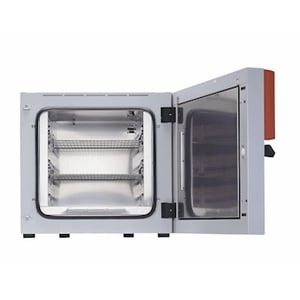
Laboratory ovens are used for routine drying, curing, conditioning, aging, and materials testing. LabRepCo carries benchtop and floor-standing models for research and industrial applications. Options include forced convection, natural convection, and vacuum ovens with standard or programmable controls.
Start with the material you are heating and the result you need. Airflow, temperature range, chamber size, recovery time, controls, and power requirements will help narrow the options. Available brands include BINDER, Memmert, SHEL LAB, Jeio Tech, and Benchmark Scientific.
Forced convection ovens circulate heated air with a fan. They generally recover faster after the door opens and maintain more consistent conditions throughout the chamber. Common uses include drying, curing, heat treatment, aging, and materials testing. The airflow can disturb powders, foils, or other lightweight samples.
Natural convection ovens have no circulation fan. Heated air rises through the chamber on its own, creating gentler conditions for powders, foils, and samples that may move under forced air. Review each model’s uniformity and recovery data at the temperature you plan to use.
Vacuum ovens combine heat with reduced pressure. Laboratories use them for drying, degassing, outgassing, and processes that call for lower-temperature solvent removal. The oven, pump, fittings, and materials must all be suitable for the application, especially when solvents are involved.
| Oven type | How heat moves | Common reasons to choose it | Important caution |
| Forced convection | A fan circulates heated air | Faster recovery, general drying, curing, heat treatment, and material testing | Airflow can disturb light samples or powders. |
| Natural convection | Warm air rises without a fan | Gentle heating when low air movement matters | Recovery may be slower. Compare model-specific uniformity. |
| Vacuum | Heat operates under reduced pressure | Lower-temperature drying, degassing, and outgassing | Confirm pump compatibility and solvent rating for the exact process. |
Begin with the process requirements, then check manufacturer data at the temperature and load you expect to use. These factors will help narrow the catalog.
Temperature range Set the required working range first, then allow reasonable headroom. Check the limit for the exact model rather than relying on the series name alone.
Airflow and sample behavior Consider how the sample will react to moving air. Forced convection suits many routine processes, while natural convection is gentler on lightweight materials.
Capacity and loading Measure the working load and vessels before choosing a chamber. Leave the clearance needed for safe loading and proper airflow.
Uniformity and fluctuation Review the manufacturer’s values at the temperatures you will use. Performance can change with the load, setpoint, shelf position, and chamber size.
Heat-up and recovery Published heat-up and recovery data matter when cycle time is important. General estimates are rarely useful across different oven families.
Controls and records Choose between basic setpoint control and features such as programmable ramps and dwells, data logging, alarms, or network access.
Power and installation Before ordering, check the voltage, amperage, plug or hardwire requirements, ventilation, clearances, access, freight, and final placement.
Material and solvent safety Use flammable or combustible materials only in equipment explicitly rated by the manufacturer for that use. Confirm the full process with the safety team.
LabRepCo carries several oven families. Availability and specifications should be confirmed on the final product page.
A forced convection oven uses a fan to circulate heated air. A natural convection oven relies on warm air rising through the chamber. Forced airflow often improves recovery and uniformity, while natural convection is gentler on lightweight samples.
Temperature limits vary by model and series. Select models reach 300 C, but the required operating range should be confirmed on the product page and manufacturer documentation.
Only equipment explicitly rated by the manufacturer should be used for flammable or combustible materials. A standard general-purpose oven should not be assumed safe for that process.
Measure the working load and the vessels it uses, then allow room for shelf clearance and airflow. Follow the manufacturer’s loading guidance for the model you select.
Laboratory ovens support higher-temperature heating and drying processes. Incubators are designed for stable, lower-temperature environments used for biological samples and cultures.
Need help narrowing the options? Send us the required temperature range, chamber size, sample type, voltage, and any programming or documentation needs. LabRepCo can recommend suitable models and confirm availability, lead time, freight, and purchasing options.
Placement note Keep the first two introductory paragraphs above the product grid. Place the comparison table, buying guide, brand overview, FAQs, and CTA below the grid. Do not hide all core copy inside collapsed accordions.
Submit a PO
Looking to submit a purchase order rather than buying online? Click on the Submit a PO button to learn more.
Sales & Support
Customer Service
Mon - Fri: 8AM to 5PM ET
101 Witmer Road, Suite 700
Horsham, PA 19044
Would you like us to get in touch with you? Fill out the form below and we will contact you.