
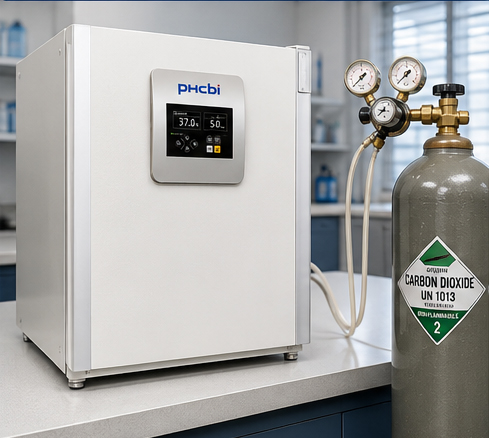
CO₂ incubators are engineered to maintain precise environmental conditions for sensitive cell culture applications. Temperature, humidity, and CO₂ concentration are closely monitored, but one upstream variable is often overlooked:
CO₂ supply pressure (PSI)
Improper PSI is one of the most common causes of incubator performance issues, premature component failure, and avoidable service calls. The issue is rarely the incubator itself. It is almost always the gas delivery setup.
The “Ballooning Tubing” Problem: A Preventable Failure
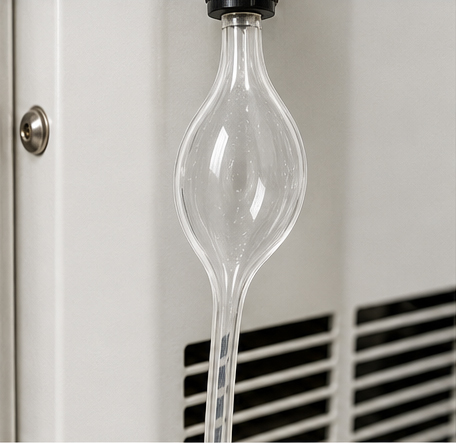
Service teams often encounter what is informally called the “balloon animal” effect, where tubing expands dramatically due to excessive gas pressure.
This occurs when:
- CO₂ pressure exceeds recommended levels
- Tubing material stretches beyond its tolerance
- Structural integrity is permanently compromised
Even if the tubing does not immediately rupture, it becomes a future failure point that can lead to leaks or disconnections.
What Is the Correct PSI for a CO₂ Incubator?
Most CO₂ incubator manufacturers recommend maintaining inlet gas pressure within a relatively low operating range, typically around 10–20 PSI, to ensure stable CO₂ control and proper system performance.
Many incubator manuals specify approximately 15 PSI as an ideal target pressure, while also cautioning against excessive inlet pressure that may damage tubing, valves, and other internal components. In general, pressures above roughly 20–25 PSI can increase the risk of over-pressurization and premature component wear.
Additionally, gas system design guidance notes:
- Typical operating ranges fall between 6–15 PSI at point-of-use
- Pressures above ~30 PSI can cause component failure and gas release
Bottom line:
The safe and effective operating range for most incubators is 10–20 PSI.
Why High PSI Is a Serious Problem
Excess pressure does more than damage tubing. It disrupts the entire incubator system.
Equipment risks:
- Tubing expansion and rupture
- Premature failure of solenoid valves
- Inconsistent CO₂ delivery
- Reduced control accuracy
CO₂ incubators rely on low-pressure solenoid injection systems to maintain precise gas concentrations. When pressure is too high, these systems cannot regulate flow effectively, leading to instability.
The Hidden Safety Risk: CO₂ Leaks
When tubing fails due to over-pressurization:
- CO₂ may leak into the lab environment
- Leaks can occur inside equipment, making detection difficult
- Oxygen displacement can occur in poorly ventilated areas
CO₂ is not toxic, but it is an asphyxiation hazard at elevated concentrations, particularly in enclosed lab spaces.
Even small leaks can:
- Increase operating costs due to wasted gas
- Affect incubator performance
- Trigger unnecessary troubleshooting or service calls
The Root Cause: Incorrect Regulator Selection
In most cases, the issue originates from the wrong regulator.
Common mistake:
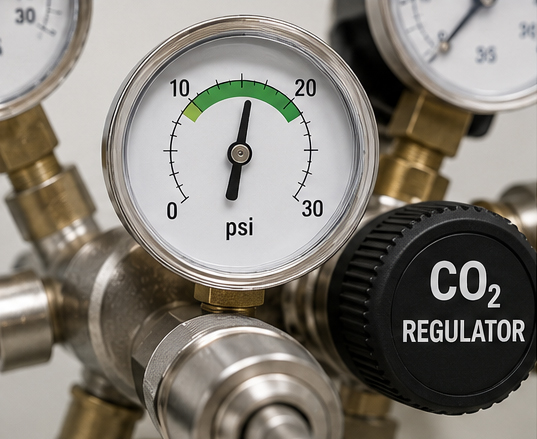
Using a high-pressure regulator (e.g., 0–200 PSI range)
Why this fails:
- Small adjustments result in large pressure changes
- Fine control is nearly impossible
- Over-pressurization happens easily
Best practice:
Use a low-pressure regulator (0–30 PSI range) that allows precise adjustment within the incubator’s required operating window.
Best Practices for CO₂ Incubator Gas Setup
To ensure optimal performance and prevent downtime:
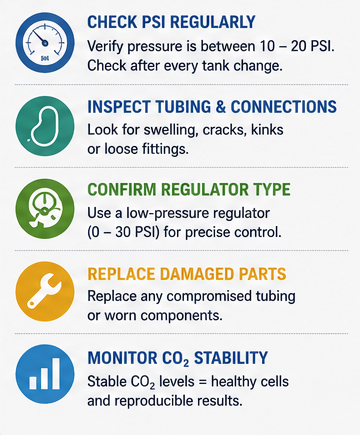
1. Use the correct regulator
- Low-pressure, high-precision regulator (0–30 PSI range)
2. Maintain proper PSI
- Target range: 10–20 PSI
- Ideal baseline: ~15 PSI
3. Check PSI regularly
- After every tank change
- During routine maintenance checks
4. Inspect tubing and connections
- Look for expansion, cracking, or stress
- Replace compromised tubing immediately
5. Adjust for system complexity
You may need slightly higher PSI if:
- Running multiple incubators from one tank
- Using long tubing runs
- Operating from a central gas manifold
In these cases, increase pressure gradually and monitor system response carefully.
Why PSI Control Impacts Cell Culture Outcomes
This is not just a mechanical issue. It directly affects your science.
CO₂ incubators regulate:
- pH via bicarbonate buffering systems
- Gas exchange for cell metabolism
- Environmental stability for reproducibility
If CO₂ delivery is inconsistent due to improper pressure:
- pH control becomes unstable
- Cell growth conditions fluctuate
- Experimental reproducibility suffers
Maintaining stable gas delivery is therefore critical to experimental integrity.
Key Takeaways
- Most CO₂ incubators require 10–20 PSI input pressure
- Over-pressurization leads to equipment failure and safety risks
- The most common issue is incorrect regulator selection
- Routine PSI checks can prevent downtime, leaks, and service costs
- Proper gas control improves both equipment lifespan and research quality
Frequently Asked Questions
Most CO₂ incubators operate best between 10 and 20 PSI, with ~15 PSI being a common target recommended by manufacturers.
Excess pressure can cause tubing to expand or rupture, damage internal valves, create gas leaks, and lead to unstable CO₂ control.
Yes. Pressures above recommended levels can shorten the lifespan of solenoids, regulators, and internal components.
PSI should be checked:
-After every tank replacement
-During routine maintenance
-Anytime performance issues arise
A low-pressure regulator (0–30 PSI range) is recommended to allow precise control and prevent over-pressurization.